Only what your store says.
Label answers from your product pages, catalog and policies, cites them, and checks each answer against them before a shopper sees it. When your data doesn’t have the answer, it says so.
Every answer is checked before it’s shown.
An answer has to name its source. When the source is a quote from your product page or your knowledge base, Label looks for it there, word for word. Contact details have to be ones your store publishes. If anything fails, the answer isn’t shown: it’s written again, and if that fails too, the shopper isn’t shown an answer at all.
- Sources named on every answer
- Quotes found word for word
- No contact details your store doesn’t publish
- Nothing shown that fails
Q How long does it burn?
AAbout 45 hours1. Trim the wick before each light so it burns evenly2.
From the product details
- ✓1 · Source. Quotes the product page, “Burn time: about 45 hours”. Found word for word.
- ✓2 · Source. Quotes the store’s FAQs, “Trim the wick before each light”. Found.
- ✓Contacts. No email, phone number or link the store doesn’t publish.
Earlier draftBurns for up to 60 hours with proper care.
- ✕Its source, “up to 60 hours”, isn’t on the product page. Not shown; written again.
Your data, first
Three sources, all yours. Facts about your products and your store come from nowhere else.
- Product pages
On any website, Label reads each product page itself: its structured product data first, then its product tags, then the main content. Only pages on your own domains are read.
- Your catalog
From Shopify or WooCommerce: titles, descriptions, options, specs, price, stock and ratings, kept current as you change them.
- Knowledge
What you write once in the dashboard: shipping, returns, warranty, FAQs, legal notes and brand notes. Used wherever it applies.
What a shopper sees says which it came from: From the product details, From the product specs or From the store’s policies. Reviews, when your catalog has them, are attributed as such: “several reviewers say it runs small”.
Facts only your store can state
Some things are never filled in from general knowledge. If your data doesn’t say, neither does Label.
- Price and stock
- Your data only
- Shipping, returns, warranty
- Your data only
- Compatibility
- Explicit statements only
- Ingredients and allergens
- Explicit statements only
- Safety
- Explicit statements only
For allergens, safety and compatibility, only an explicit statement counts. “No nuts listed” doesn’t mean nut-free, and “fits most machines” doesn’t mean it fits a particular one.
For supplements, cosmetics, baby products and health devices, Label repeats your store’s claims with attribution (“the store says…”), gives no personal medical or safety advice, and keeps a neutral tone whatever voice you’ve chosen. It never recommends other stores, or products you don’t sell.
General info, kept apart
Background your data doesn’t have, when you allow it, and always labeled.
General info is what’s generally true of a kind of product, such as how a material behaves. It sits under its own General info label, never mixed with your facts, and you choose how much is allowed: none, what’s true of the category, or also well-documented facts about the exact product.
- Never covers price, stock, shipping, returns, warranty, compatibility, ingredients, allergens or safety.
- Never contradicts your data.
- A statement with a number your store doesn’t state, or a contact it doesn’t publish, is dropped before anyone sees it.
- No claims of “newest”, awards, outside review scores or comparisons with other brands.
When your data doesn’t say
It says so, and tells you.
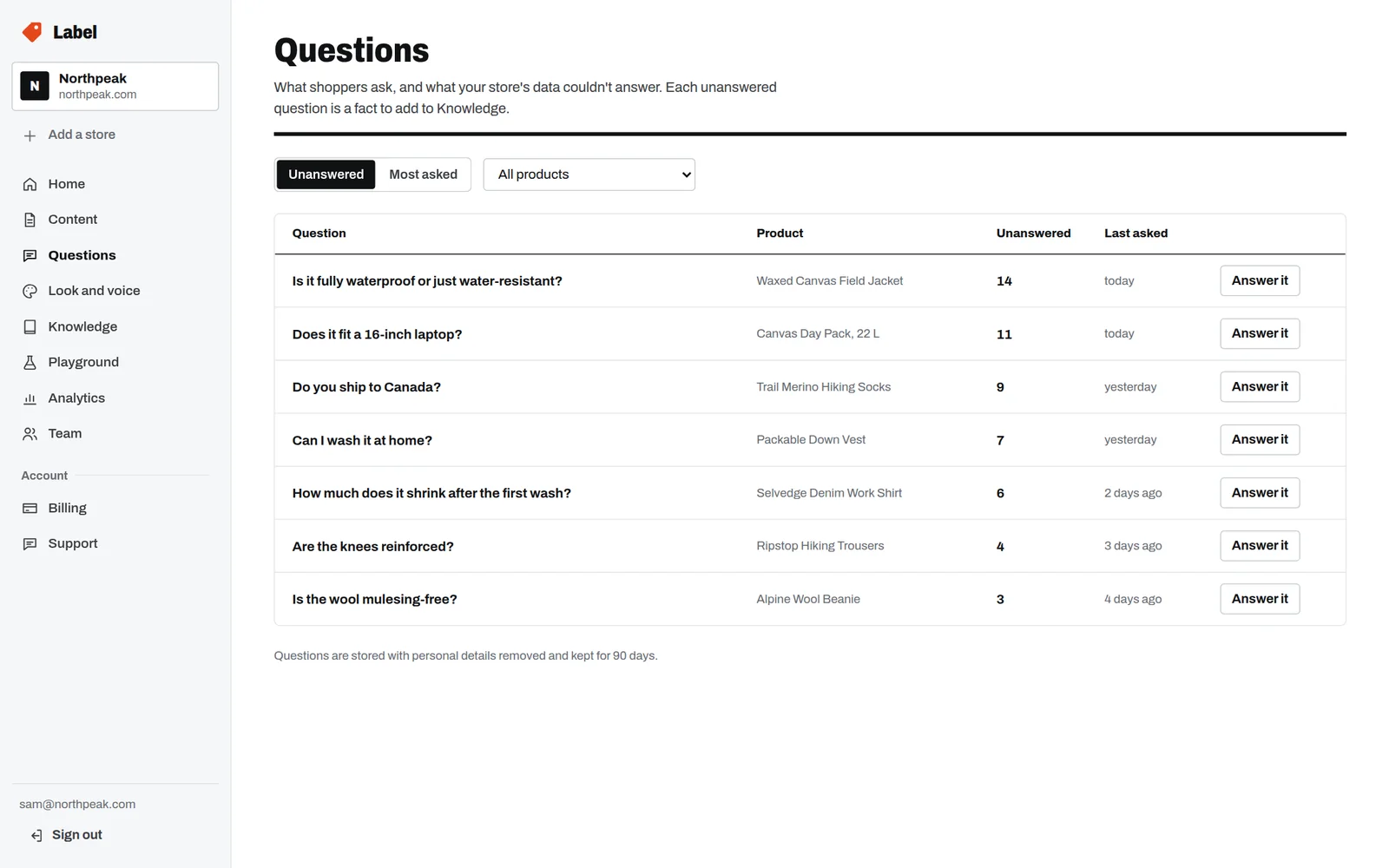
When your data doesn’t cover a question, the shopper is told the store doesn’t say, rather than given a guess. The question goes to the Questions page in your dashboard, with how often it’s been asked. Add the fact once in Knowledge, and every product it applies to can answer it.
Shoppers rate it. You decide.
Ratings improve what’s written; your edits are final.
- Ratings
Every summary and answer has Helpful and Not helpful. Not helpful asks why: incorrect, unclear or not relevant.
- Rewrites
Content rated poorly is written again, within a daily limit, so votes can’t run up your credits.
- Your edits
Edit anything and it’s locked: never rewritten, and never dropped by votes. If the product changes, it’s flagged for you to review.
- History
Each item keeps its versions, with what changed and why.
Not taken in by what it reads
Product pages, reviews and questions are data. They can’t give Label orders.
Everything Label reads, from your product pages and reviews to a shopper’s question, is passed to the AI as information, never as instructions, and the AI is told to ignore any of it that tries to change its rules, reveal its prompt or point shoppers elsewhere. Questions that aren’t about the product get a short, polite refusal.
Your own store instructions in the dashboard steer what to focus on and how to word things, within the same rules. They can’t add facts: something stated only in your instructions is never used as one.
Always labeled as AI
Shoppers always know what they’re reading.
Every view of the widget says it’s AI-generated, with a short reminder to check important details. You can add your own disclaimer as well; it’s shown as you wrote it.
Answers you can stand behind.
Try Label on your own products and read every word it writes before you go live.